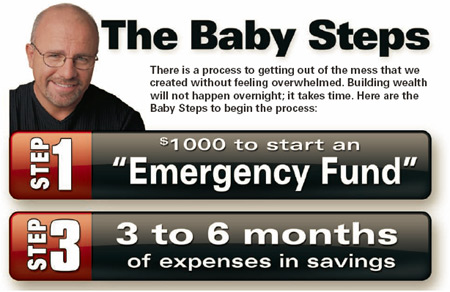
Today I wanted to post on Dave Ramsey's Baby Step #3, Fully Funding your Emergency Fund. If you are on this step, that means that you have completed Baby Step #1, the $1000 beginner emergency fund, and also Baby Step #2, the debt snowball. So now, you are completely out of debt (except your house). This step (#3) is probably the easiest to understand, but not the easiest to actually DO.
If you’ve been working the Baby Steps and you paid off your debt using the debt snowball method, that means you can simply start putting the same amount of cash that you were giving to someone else and put it in your savings account instead. For instance, if you paid your last Discover Card bill of say $500 in April, now in May redirect that $500 to your saving account. Your monthly budget will stay the same for a while as you get that emergency fund nice and fat.
Q: How much should I have in my Fully Funded Emergency Fund (FFEM)?
A: That depends. Most financial experts recommend 3-6 months of expenses, not income. Big difference. I think the best way to determine how much you need, is determine where you will feel "peace". For my family, we feel we need the 6 months of expenses. If you are single, with a steady, secure job, 3 months may be adequate. If you are self employed, like my husband, 6 months may be better. Suze Orman changed her response from 6 months to having a full 8 months of expenses saved. Talk it over with your spouse, and decide how much you would need. When figuring out how much your expenses would be per month, remember that in a true emergency, you would spend far less than your income. If you lost your job, what budget categories would you still need? These usually end up being: mortgage or rent, utilites, food, gas, insurance, and phone service. In the event of a true emergency, you would probably cut out or spend significantly less on eating out, entertainment, lessons, gift giving etc. Lets take a look at the Smith's (a fictional family). Here is what they think they can get by with in an emergency:
- Mortgage: $1000
- Utilities: $250
- Gas: $100
- Food: $300 (they use/rotate their food storage)
- Phone: $100
- Insurance: $400
Total: $2150 per month
For 3 month FFEF: $2150x3=$6450
For 6 month FFEF: $2150x6=$12,900
For 8 month FFEF: $2150x8=$17,200
Because the Smiths are self employed and have several children, they decided to make their goal be $15,000.
Q: What constitutes an emergency?
A: An unexpected event such as a medical emergency, a job loss, a car wreck, etc. Christmas is not an emergency. A "great deal" on a new bedroom set is not an emergency, nor is a dream vacation to Hawaii. It is great to save up for these things, but not with the emergency fund.
Q: Where should I store my emergency fund?
A: Dave Ramsey said that any bank savings account is fine. It needs to be liquid, or in other words, easily accesible. However, you don't want it
too accessible. We decided to put ours in an "add-on CD" through our credit union. We get 3.5% interest on it, can withdraw it penalty free for 5 days each quarter, and add to it as often as we want. If we needed to withdraw it anytime besides those 5 days, we would lose the interest for that quarter. We decided that was still better than getting the terrible interest rates that the banks are offering in their savings accounts. Another option is online banks. They usually give you a higher interest rate.
Q: How long will this take?
A: That depends on how much you are going to save each month, how committed to putting every extra penny in the account, and the interest you are receiving. If you could put $1000 per month into your emergency fund, it would add up pretty fast. Our example of the Smiths could have their FFEF done in just over a year.
Q: Is it worth it to sacrifice a bit longer to fully fund my emergency fund?
A: Think ahead a year.... you decided that you didn't think YOU needed the emergency fund. Unfortunately your husband lost his job, or your car died. Even worse, you had a medical emergency in your family. Now, do you think it would have been worth it? Having the peace of a fully funded emergency fund is one of the greatest goals I think anyone can have.
YES, it is worth it.
Below are some quotes on Emergency Funds:
"What do you do when your car breaks down in the morning, your wife calls later to tell you the dog ate the sofa, you lose your biggest account in the afternoon, and when you get home in the evening you find a note from the plumber saying he replaced the living room baseboard, and P.S., your furnace is dead? You express deep gratitude for your contingency fund, that's what."
— Jerrold Mundis, How to Get Out of Debt, Stay Out of Debt, and Live Prosperously
"Maybe you've felt it. The rush in the pit of your stomach when you hear the pinging sound in your car, and you wonder how you'll ever pay the mechanic. The tightness in your chest when the plumber tells you it will be $185 to fix the shower. The rock-hard knots in your back when you realize that the check you mailed to the electric company will probably bounce.
These are the feelings of not having any Savings. And when you start to save — when you really sock it away, month after month — these feelings stop. You can put these feelings in a box and mail them to the moon, because they won't be with you anymore."
— Elizabeth Warren and Amelia Tyagi, All Your Worth (2005)
"The basic truth is that you must plan for the unexpected, because it will happen. Although we don't know what form it will take, it will come. Cars do break; women do get pregnant; people do get hurt or die; businesses do lay people off. To think otherwise is naive. So you have to plan for it. Saving into an emergency fund is an essential element for financial peace."
— Dave Ramsey, Financial Peace (1995)
"You start the emergency fund with $1,000, but a fully-funded emergency fund will usually range from $5,000 to $25,000. The typical family that can make it on $3,000 per month might have a $10,000 emergency fund as a minimum. What would it feel like to have no payments but the house, and $10,000 in savings for when it rains?
Remember what we said about emergencies a couple of chapters back? It will rain; you need an umbrella. When the big stuff happens, like the job layoff or the blown car engine, you can't depend on credit cards. If you use debt to cover emergencies, you have backtracked again. A well-designed Total Money Makeover will walk you out of debt forever. A strong foundation in your financial house includes the big savings account, which will be used just for emergencies."
— Dave Ramsey, The Total Money Makeover (2003)
"The amount you need in your emergency fund is not the same as what you earn in three to six months. It's also not what you typically spend. When you're working, you spend much more freely than you would if you were just trying to get by."
— Jean Chatzky, You Don't Have to Be Rich (2003)
"Why bother to become a better saver? Because boosting your saving prowess can have a huge emotional payoff. Nine out of ten savers say they're 'happy' with their lives. Savers are more likely than spenders to be happy with their lifestyle, self-esteem, even their weight and appearance. They're more likely to feel confident and content, less likely to feel stressed and restless. Spenders are just the opposite: They're more likely to be frustrated with their lot in life."
— Jean Chatzky, You Don't Have to Be Rich (2003)
Small steps are inevitably going to be your first steps, and they definitely count. Once you have put aside $25 one week and discovered that you can live in fact without that $25 in your spending account, then you have the confidence to know that you can do it again. You may even have the confidence to think, "Well, hey, if I put aside $25 and I didn't miss it, I'm going to try to put $50 aside and not miss it."
— Jean Chatzky, Bankrate.com Interview, 2007-07-23
"You need to understand and know that the main unknown in your financial life — and where most people tend to get in trouble with their money — is when something happens that you are not expecting. A job loss, an accident, a family crisis, an illness (either your own or that of a parent or child), a death or disability, or an unexpected divorce — each is an unforeseen even that affects your expenses and finances. When an unforeseen event does occur, your biggest problem usually will be to know where to get the money you need to pay for your known expenses and your unknown, unanticipated ones until you can become safe and secure again. Keep in mind that your financial world can be shaken or destroyed by very common, unforeseen possiblilties. This has always been the case, of course — and in a time of economic and global uncertainty, it is especially true. People who sail through difficulties with relatively little financial harm do so because they have prepared for them."
— Suze Orman, The Laws of Money, The Lessons of Life (2003)
"Another problem that you may encounter in preparing for the unknown is that you find it hard to save — and can't imagine setting up an account with eight months worth of expenses in a short amount of time. Well, my friend, if this is the case, the way for you to create an emergency fund is simply to take every extra penny you have, put it into a money market account, and save it there. You have to make a decision here. Which means more to you — having a Starbucks coffee this afternoon and going to the movies tonight, or knowing that you and your loved ones will be protected even if you lose your job or get sick? Doing what is right for you — including making sure you'll have what you need in any sitution — may mean giving up what you want right now to pay for what you could need later on. I hope you decide to do this, for you'll be amazed at how much control over your life you will feel with your emergency fund standing behind you."
— Suze Orman, The Laws of Money, The Lessons of Life (2003)