Showing posts with label financial peace university. Show all posts

Sunday, May 9, 2010

Financial Peace University Week 13: The Great Misunderstanding

This last week was our last Dave Ramsey Financial Peace University Class!  It was such a great class.  If anyone has the opportunity to take it, I highly recommend it.  We loved being the moderators.  We learned so much!  The staggering thing to me was how much debt our class paid off.  On the last night of class, we calculated the totals.  Averaged out, each couple paid off $6974.47 and saved $6,323.33!!  And that was in only 91 days!!! Fabulous!

This week – "The Great Misunderstanding"- being a good steward over what we have been given, and GIVING!!

Key points:

  1. The Great Misunderstanding, the paradox, is that we believe that the way to have more is to hold on to what we have more tightly.
  2. A steward is a manager, not an owner.
  3. Give the first 10% of your income to your church or favorite charity.
This was one of my favorite lessons.  Some people think that holding on tightly (clenched fists) to everything we have is the way to get more.  Wrong!  Here’s a passage from the Dave Ramsey website on avoiding “stuffitis” and finding true contentment.
In 1913 a cartoonist named Arthur R. Momand coined the phrase “Keeping Up with the Joneses” when he created a daily comic strip by the same name. The strip was Momand’s satirical take on his experiences living in an affluent society. It struck such a cord with Americans that it ran for 28 years.
We’re not that much different today. We still strive to keep up with friends, neighbors and even strangers – partly because we inherently crave prestige and partly because we’re bombarded with ads for all the things that will allegedly make us happy.
Dave says that the most important key to financial peace is not budgeting, debt snowballing or investing. The key is contentment. You have to know how to be content with less before you’re able to dig in and do the practical things that lead to financial freedom. Ironically, the people who are most content with their finances and their possessions are those who actually have less.
Marty Nemko of Bankrate.com says, “Most wealthy people know that additional money beyond a fairly modest income yields little additional happiness.”
In her book You Don’t Have to be Rich, Jean Chatzky goes a bit further and says, “The financial habits of people who believe money equals happiness stand in the way of achieving that happiness.” This type of person is less likely to do the things that lead to true contentment and control.
So what’s the answer? How do we go against the grain of a greedy, possession-driven society? One thing we can do is not allow our possessions to possess us. Working just to buy the best clothes, the newest car, the latest technology or the biggest house is futile. Our aim should be a life of peace and freedom where our family, health, and wholeness are the priorities.’
 He spent some time talking about how we are merely managers of our money, and that God is the owner.  He said it is much easier to give when it is someone else's money!  If we remember this principle that we are the stewards, it will be easier to give.

He then talked about the importance of giving your first 10% to your church or charity.  He explained that even while in debt, we should be giving.  He explains: 
Nearly every day callers to “The Dave Ramsey Show” ask Dave, “If I’m still in debt, should I stop giving to my church or charitable organizations?”

For Christians and practicing Jews, this is a slightly more complicated situation because the Bible and the Torah instruct believers to give at least 10% of their income to the church. There are many people who simply want to be able to give whether they attend church or not, but they don’t feel they can afford it while they’re working the debt snowball.
In this situation, Dave offers some very sound and simple advice: give.

While it may be tough during the rice-and-beans, debt-dumping days of Baby Step 2, Dave says that even if it’s not much, don’t worry. It’s not about the amount or what it does for the organization to which you give. It’s about what it does to you, deep down inside.
You’ll be happier, healthier, and you’ll get so much more out of life when you intentionally and regularly give. Plus, continuing to give during the financially dry spells will solidify in you a spirit of generosity that will carry over when you’re cup is overflowing!
Whether you give to your church, your synagogue, or a charitable organization, just give. And even if you’re working the debt snowball, just stick to your budget and you’ll be in good shape.
There are three things to do with money: spend, save and give. You have to spend in order to have the things you need to live and should save in order to secure your family’s future. But there’s something special about giving, something about the way it refreshes your heart and helps you see what is most important. No matter the amount or the recipient, just give.

Thursday, April 15, 2010

Financial Peace University: Week 9: Of Mice and Mutual Funds

This week was about the basics of investing.


Yay! By this point in the Financial Peace University program, we are learning about Baby Step #4, INVESTING! Dave advocates investing 15% of your household income in mutual funds.  By this baby step, you have paid off all consumer debt (except the mortgage), and have a 3-6 month emergency fund saved.  Now it is time to start building some wealth.  Dave Ramsey teaches that mutual funds are a great way to invest.  Of course, in an hour long lesson, we will not know all of the in's and out's of investing, but he points us in the right direction.

His first rule of investing is to never buy something you don’t understand. Only invest in companies and products that you can explain to a seventh grader. Stick to things that are easy to understand, or in other words, use the "KISS" principle: KEEP IT SIMPLE STUPID! Often times, financial planners or investment counselors use such complex terms that we don't know what we are getting into.  Keep it simple, and understand everything you buy.  Investing is methodical, week by week, month by month.


Dave begins by covering the basics of risk versus return. In other words, the safer and more liquid (accessible) that you want your money to be (low risk), the lower the potential return will be.  Safe investments are typically CD’s and money market mutual funds.  However, they tend to often time not even come close to the rate of inflation.  Riskier investments (with generally higher rates of return) include single stocks (Dave says DON'T DO THAT), bonds, mutual funds, and real estate.  Real estate is one of Dave's favorites, but only when he can pay cash for it.  Real estate takes a lot of money to get into, and also to maintain. It should not be used for short term investments, but has a great return for the long term.


He spent quite a bit of time talking about diversification, or not "putting all of your eggs in one basket". This protects your investment more than about anything.  Diversification is investing your money in many different products, companies, and levels of aggressiveness. You don’t want to have all of your money in one company’s stock (even if it’s the company you work for), or one mutual fund.  If for some reason that company crashes, you will lose all of your money.  Investing in multiple funds, stocks, and industries makes sure that even if one company or product tanks, your others will take up the slack. This makes it much less risky. Dave’s standard mutual fund diversification is as follows:


25% in Growth (mid cap): These are mid-sized companies that still have a lot of room for growth.
25% in Growth and Income (large cap): These are big, well established companies that grow a little but mostly stay stable.
25% in International: These are overseas and foreign companies.
25% in Aggressive Growth (small cap): These are small companies and emerging markets that have a lot of potential to grow, but alo have a lot of potential to crash.


Dave then tells us that your money will need to earn at least a 6% return in order to compensate for inflation and taxes. With that you simply break even. Dave shoots for an average of 12% return with his mutual funds. With the down markets we have had over the last several years, that would be hard to come by. He also recommends funds that have a strong track record for the past 10 years.


All in all, this class was an eye opener for me (and the class). When we looked at how debt has robbed us from earning real wealth, it was sickening.


Click here for a visual representation of what saving 15% of your income can look like. This is from Doughroller.net, and it puts it all in perspective.

Tuesday, March 23, 2010

Financial Peace University Week 6: Buyer Beware

This week – Buyer Beware!

This week we talked about common traps to avoid when buying things.   Some of the important points from the lesson:
  1. Learn the marketing method companies use to market products and services to you. You can be in control!
  2. Wait 24 hours before making a major purchase larger than $200 (or whatever amount you and your spouse decide on).
  3. Always talk to your spouse before making a major purchase.
Know the marketing techniques businesses are using to get you to SPEND:

Almost all businesses use highly trained individuals to get you to buy their product.  Most companies use the same tactics and marketing ploys.  Why? Because they work!  If we know what the tactic is, we can spot it, and hopefully not fall into the trap.

For example, one tactic a lot of companies are using is the 0% financing offer.  They lure you into buying a product (dryer, a car, a big screen TV, etc), with the 0% offer.   What they don’t tell you (except for in the fine print) is that if you don’t pay the balance of that loan in full by the time the initial term is over, your finance rates will shoot up considerably (often to 30% or more) , and you’ll often be liable for the finance charges for the 0% term as well.  Or, if that isn't bad enough, the cost of the 0% financing is already added in to the product you are buying.

Wait 24 hours before making a major purchase:
This one step is crucial.  This often eliminates the impulse purchases we all make.  If after the 24 hours you really need it, and you have the cash to pay for it, great.  Often times when we wait for the 24 hours, we realize that we really didn't need or want the item.  It was just a spur of the moment impulse.
Always talk to your spouse before making a major purchase:
Only after discussing and counseling with your spouse should you make a major purchase.  This keeps the lines of communication open, and the trust there.  Often times your spouse can help us decide if we really should get the item.

Look at the opportunity cost of the item:
This means, look at what you are giving up to buy that item.  Is it worth it??

Understand about the item before you buy anything:
Dave Ramsey talks about how we should never purchase anything that we don't understand.  This could be for insurance, mutual funds, or even a new camera. 

Next week
Next week is a lesson entitled “Clause and Effect” which deals with common traps to avoid when buying insurance of all kinds. See you next week!

Saturday, March 6, 2010

Financial Peace University Week 4: Dumping Debt

This was one of the most intense weeks ever in class!  The DVD was very inspiring and motivating.  At the end of the class, each of us were ready to go and conquer any and all debt!
This week's lesson: Dumping Debt!

Last week our class added up the total amount of debt (not including the home mortgage) that we had.  I was FLOORED.  The total came in at just under $460,000!!  Wow.  This lesson really hits home for a lot of people.

Imagine being DEBT FREE.  Dave teaches about how to do this, which is Baby Step #2 – Paying off all debt using the debt snowball.

Key points from this lesson:
  1. Being Gazelle Intense is the only way to conquer debt.  A lax attitude will not get you very far!!  As Dave Ramsey says, "YOU HAVE GOT TO KICK IT BABY!"
  2. Debt has only become accepted as normal in America in our generation.  Our great grandparents abhorred debt.  Our grandparents didn't like debt.  Our parents used debt for the big stuff (house and car), and we use debt for EVERYTHING.
  3. Make a commitment to never use credit cards again. This is the first and most important step to dumping debt. In class, we had people come up and cut up their cards.  It was very emotional, and liberating.
  4. Do not become slave to the FICO score. It seems that we will do anything to have a good credit score.  It really is an "I love debt score".  Some people claim that credit is the only way to: rent a car, get a mortgage, etc.  Dave says that there are other ways to accomplish these things.  A debit card has the same protection as a credit card.  And yes, you CAN get a mortgage without a FICO score.  Debt should never be the first way to accomplish anything.
  5. The rich rule over the poor, and the borrower is servant to the lender. Proverbs 22:7
Baby Step 2 – The Debt Snowball I previously posted on this topic in detail, so click here to get the info.  Here is the short version of Baby Step #2, The Debt Snowball.
Here’s how the debt snowball works:
Step 1 – Make a list of all your debts, ranked in order from the highest balance to the smallest balance.
Step 2 – Beginning with the card with the smallest balance, pay as much as you can on that card while paying the minimums on the other cards.
Step 3 – Once the card with the smallest balance is paid off, take the amount you were paying towards that card and apply to the card with the next lowest balance.
Step 4 – Keep on paying them off until ALL the debts are paid off.

Steps to getting out of debt:

  1. Quit borrowing more money!! Commit right now to NEVER take out any more debt.
  2. Cut up your credit cards. This was hard for me!  Although I haven't used credit cards for several years, I have kept them for an emergency.  No more!
  3. Get an extra job. Even if it is temporary, the extra income can really accelerate the debt snowball.
  4. Sell stuff.  Plan a yard sale or put stuff on ebay.  Use the cash to pay toward your debt.
  5. Get the debt snowball rolling! Pay off the lowest debt first, then add the amount you were paying for that debt and roll it over to the next debt.
  6. The average person who applies these principles is DEBT FREE except for the house in 18-24 months!!!
Here is the Dave Ramsey Debt Snowball Form:


Debt Snowball Form

Friday, February 26, 2010

Financial Peace University: Week 3: Cash Flow Planning

This week in our Financial Peace University class, we learned about "Cash Flow Planning", or in other words, the big B word..... BUDGET!!  It is so true, if we don't tell our money where to go, and what to do, it disappears. Money that has a name, and a purpose, on paper, goes farther.  I was surprised how many of our class have never kept a budget.  The problem with not keeping a budget, is that debt slowly creeps in.  Money is not accounted for, and problems begin.  With a budget, every dollar is accounted for, assigned a category, and planned how it will be spent before it ever even comes in.

Some key points from this week’s lesson:
  1. Spend all money on paper before the month begins. You don’t want money not being allocated, and then “disappearing”.
  2. Use the Envelope System for successful cash management for food, clothing, entertainment and other categories that are easily overspent.
  3. Give your budget 90 days to really start working.
  4. Plan on a fight as you do your first budget.  However, if married, each partner has a vote!!
Budget Committee Meetings:
Last week we talked about "budget committee meetings" and how each partner is responsible for the budget.  Nothing is spent that is not in the budget without an emergency budget committee meeting.  Dave said the first month you will have a whole lot of emergency budget committee meetings, but as the months progress, and we get better at our budgets, those meetings will be fewer and farther between.

Zero Based Budget
The type of budget that Dave recommends is called a zero based budget.  If you are new to zero based budgeting, click here for a detailed post how to do this. Basically, you spend EVERY dollar on paper before the month begins.

The envelope system:
After setting up your zero based budget, the next step is to setup your envelope system of budgeting for certain spending categories. If you have never used an envelope system before, basically it boils down to this:  At the first of the month, you put the budgeted amount of CASH into envelopes marked with certain categories that are easy to overspend.  For us, the envelopes we use are food, clothing, entertainment and blow money.  Simply get an envelope, take a sharpie marker, mark what category it is, and fund it with cash.  When the money is gone, it is GONE.  Overspending is virtually eliminated.  If you do need more money for that category, the money must be taken from another envelope, or another spending category. There is no free money, it has to come from somewhere!

Here is an excel spreadsheet to walk you through the zero based budget.  The fields highlighted yellow are good ones for cash envelopes.  My husband and I have done zero based budgeting for years. I love it!! It seems that money is found, and can be applied to whatever baby step in the plan you are on.  I can't imagine not living on a budget.
Click here to download excel version.

Tuesday, February 23, 2010

Financial Peace University: Week 2: Relating with Money

Last week I reviewed week 1 of Dave Ramsey's Financial Peace University.  In review, week 1 talked about the importance of:
  • Savings must become a priority.
  • You must save for an emergency fund, major purchases, and wealth building.
  • Decide and agree with your spouse on what qualifies as an emergency.
We have quite a large group attending, so I decided to split the class into 2 groups for discussions.  That seemed to be more manageable.

Week 2: Relating with Money
This week the topic of discussion in class was the importance of working together in relationships and how we as individuals handle money differently.  While the number 1 cause of divorce is money matters, this lesson I thought was particularly useful.   How we manage our money can affect our personal relationships, especially with those who we are closest with.  One spouse may be more of a "nerd", one who has a natural tendency for budgeting, enjoys it, and likes to work numbers.  The other spouse may be what Dave Ramsey calls "a free spirit", who does not like to think about budgeting, does not enjoy it, and likes to pass it off to the "nerd".  When two opposites in money matters are together, there are bound to be problems.  This is why it is important to learn to work together, and find common ground.
Some key points from this week’s lesson:
  1. Men and women think very differently about money. For men it is often more of a tool, something to be used. Men like to negotiate.  Women like to hunt for the deals. For women it often means security.
  2. The nerd and free spirit must learn how to work together.
  3. If you are single, find an accountability partner with whom to discuss your finances.
  4. Teach your children how to manage money so they avoid our mistakes.
Budget committee meetings
Dave Ramsey talks about the need for family “budget committee meetings” where both partners in the relationship talk about the monthly budget, and have a stake in it. More than once in the presentation, Dave asks, "Who is responsible for the budget?" You both are!!

Dave Ramsey states: "The challenge in a marriage is to work through the different identities, ideals and values you each bring to the relationship. You win at marriage by losing your need to get your way in every battle. You get a happy marriage by giving up selfish desires in order to win together—you create shared visions and goals out of your own individual goals!  That’s why it’s important that both spouses be involved with creating the monthly budget. The partner with the natural gift can prepare the budget, but the decision-making must be done by both of you. When you sit down with your spouse to have a budget committee meeting, there are three rules that each of you must follow.
Rules for the nerd:
  • Listen.
  • Take input.
  • Keep it brief.
Rules for the free spirit:
  • Show up.
  • Give input.
  • Be realistic.
Remember that opposites tend to attract in marriage, so work together for maximum wisdom. When you have a budget that reflects both of your goals and ideals, you will experience fabulous unity in your marriage."

Wednesday, February 10, 2010

Financial Peace University: Week 1: Super Saving

Beginning the Class
My husband and I started the Dave Ramsey “Financial Peace University” class last night, hosted through our church.  I am the "moderator" or discussion leader.  We had about 25 people come!  Most were really enthusiastic and signed up for the full 13 week course.  We are repeating lesson 1 tonight for those who were not able to come last night.  The cost for the course is $99, so it definately isn't cheap, but everyone who has been through the course that I have talked to said they would have paid much more for it!   Dave Ramsey is an engaging speaker (he had our attention the whole time- and time went really quickly), and the video series we’re watching for the class is very professional.
Week 1
The format of this particular class we’re taking is:
  1. Watch the class video for the first hour
  2. Class discussion topics
  3. Assigned homework
So what was the topic for week 1?  Super Saving!

Super Saving
We watched the video, and learned that the first step is SAVING MONEY.  Several points were emphasized:
  1. Savings must become a priority.
  2. You must save for an emergency fund, major purchases, and wealth building.
  3. Decide and agree with your spouse on what qualifies as an emergency.
It amazed me that so many people do not save at all.  Alex and I have become savers, and we agree on what is an "emergency" in our household.  Dave talked about what is NOT an emergency: Christmas, new clothes, etc.   Emergencies could include car trouble, losing a job, medical problems, death in the family and many  other things. Needing a vacation is not reason to dip into our emergency fund.
The Baby Steps
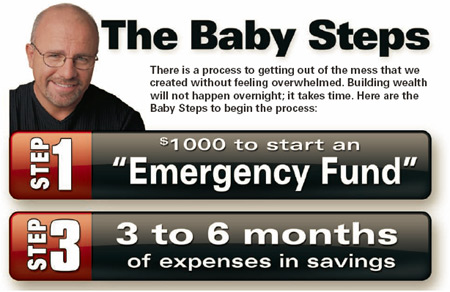
To teach how to remove debt, save, and build wealth, Dave Ramsey uses his tried and true 7 Baby Steps. This week focused on baby steps 1 and 3, which both have to do with saving.
We will get to baby step 2 in another lesson.


Baby Step 1
The first step in the plan is to have a beginner emergency fund of $1000. Dave says this step needs to be done FAST.  Most people can have this step done in 1-2 months.  The beginner emergency fund helps to repel emergencies!  By having this, when something does go wrong, say the car needing to be fixed, it does not become a crisis. 

Baby Step 3
In Baby Step 3 Dave Ramsey talks about how once we’ve got our debts paid off (baby step 2- in another lesson), we need to save 3 to 6 months of expenses and put it in a money market account somewhere. Keep the money accessible. but not too accessible.  He stated you can even keep it in your drawer, but then it seems to disappear on non emergencies- like pizza.  He talks how this step when completed brings a sense of security to the marriage.  Women especially feel more secure knowing it is there, and men have a greater marriage because of the women feeling more secure financially.  Dave also gave an analogy of a brick.  By itself, the brick is amoral.  It is not good, it is not bad.  However, if you get a real jerk with the brick, he could throw it through a window and vandalize something.  If you give a brick to a good person, he may use it to build a home for charity.  Money is the same way, in an of itself it is neither good nor bad.  It is how the person uses it that is good or bad.
Homework for next week
Our group discussed the DVD and the principles that we were taught. This discussion included why we don't save, why we use credit cards for emergencies, and reiterating why the emergency fund is so important.  After the discussion, the homework was given to read several chapters out of Financial Peace Revisted, as well as to complete the "Quickie Budget" for next weeks class. 


Fpu Quickie Budget

Sunday, January 3, 2010

New Year... Financial Peace University!!

Happy New Year!  I cannot believe that 2009 is now a thing of the past.  I loved Christmas, and New Year's, but I am sure glad to be starting a new year.  I am ready to start saving money again.  It seems like Christmas always costs a lot, even when budgeted for.

My ward is hosting Dave Ramsey's Financial Peace University!  I can hardly wait!  My bishop asked me to be the moderator of the class.  We passed around a signup sheet today, and it seems like there is a lot of interest.  We are starting the 9th of February, and I will post what is taught each week. I can hardly wait!  I love Dave Ramsey, and we have been following his plan for several years.  What a difference he has made in our lives!! Those who complete the 13 week course on average pay off $5300.00 of debt and save $2700.00 in the 90 days.  Amazing!!